
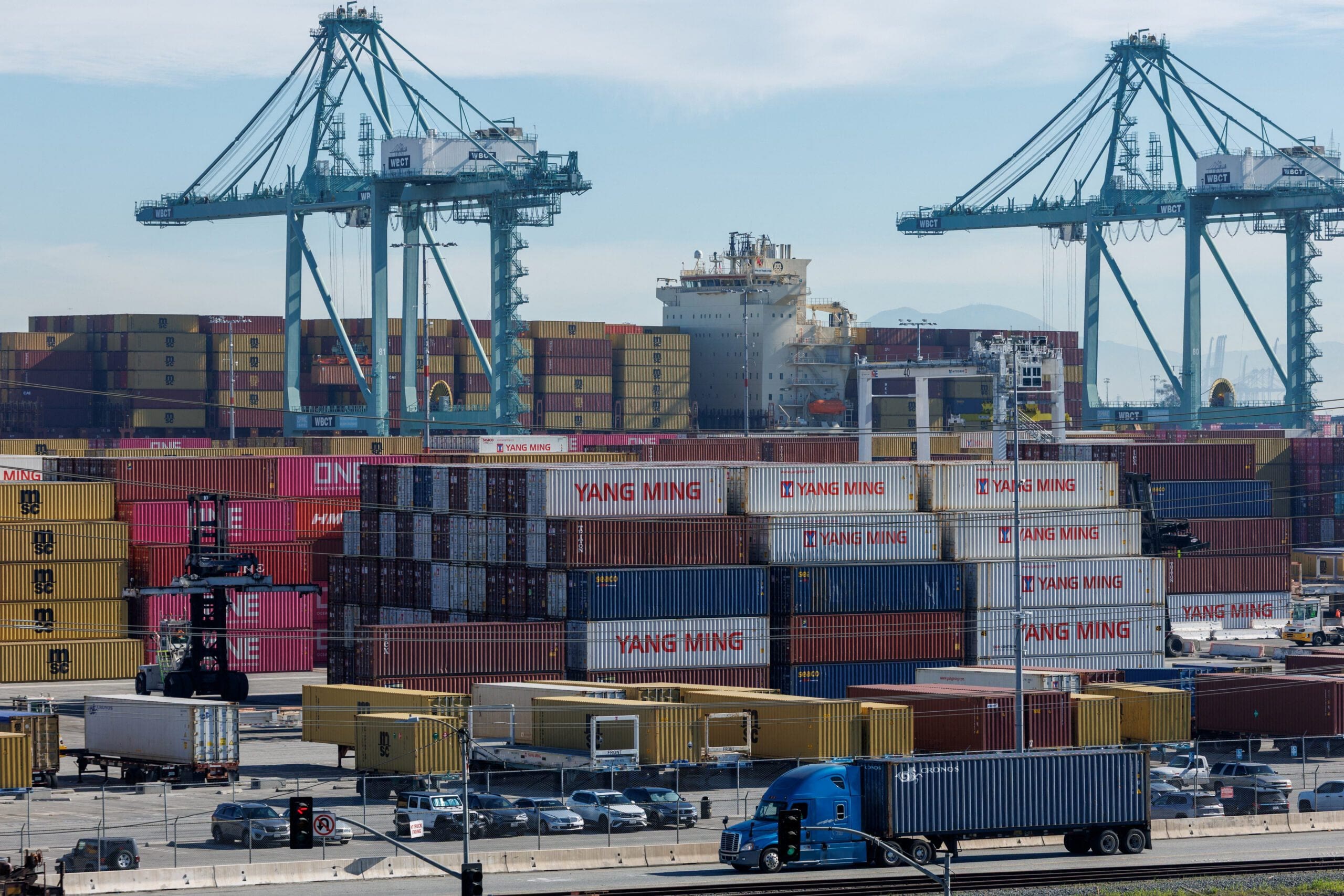
One year after President Trump’s Liberation Day tariff announcement, global trade remains fractured. The S&P 500 has lagged global peers. The IMF’s April 2026 World Economic Outlook projects Sub-Saharan Africa growing at 4.3 percent — faster than the United States, the Eurozone, and Japan. And the legal architecture of the tariff regime has been reset once already, mid-crisis.
A year of Liberation Day
April 2, 2025 — Liberation Day — was the date the Trump administration unveiled a sweeping tariff regime: a 10 percent baseline on all imports, with higher sector-specific and country-specific rates for China, Vietnam, Mexico, and the EU. The announcement triggered the largest single-day stock market decline since 2020, a bond market sell-off that briefly pushed the 10-year Treasury yield above 5 percent, and a rapid series of exemptions, negotiations, and court challenges.
The Supreme Court reset
In February 2026, the US Supreme Court ruled 6–3 that the executive’s unilateral tariff authority under IEEPA — the legal basis for Liberation Day — exceeded the statute’s scope for peacetime economic coercion. The tariffs were struck down. Within 24 hours, the administration used a different statutory pathway to impose a 15 percent baseline tariff, effectively reinstating the regime under new legal cover. The policy continuity has been near-complete; the legal architecture is different.
Africa’s divergence
Sub-Saharan Africa’s 4.3 percent growth projection in the IMF’s April 2026 outlook places the region above every major developed economy. The divergence is driven by commodity revenues (gold, oil, manganese, lithium), a demographic dividend that sustains domestic consumption, and — critically — the absence of deep supply-chain integration with the US-China trade war’s primary theatres. African exporters to the United States were hit by Liberation Day tariffs, but most export volumes are relatively small. The disruption has been primarily price-level (commodities) rather than supply-chain (manufacturing).
Repositioning as alternative sourcing
Several African industrial zones — in Ethiopia, Rwanda, and Ghana — have reported increased inbound interest from US companies seeking to diversify away from China and Vietnam. The tariff war has not yet produced a “China plus Africa” manufacturing wave, but the conversations are happening at a pace that has no precedent. The question is whether Africa’s infrastructure, regulatory predictability, and port capacity can convert that interest into signed contracts before the tariff environment shifts again.







Leave a Reply