
How AI is changing church projection in 2026
TL;DR
– AI is genuinely useful for live verse detection, semantic search, and paraphrase resolution.
– AI is not useful (yet) for sermon summarization, autonomous slide composition, or multilingual live translation.
– The right model: AI proposes, the operator disposes. Humans always hold the keys.
A pastor we work with — runs a 400-seat sanctuary in Kumasi — sent us a screenshot last month of an AI sermon-summary tool that had cheerfully attributed a paraphrase of 1 Corinthians 13 to “the Apostle Paul, writing to the Corinthian church around 165 AD.” Off by 110 years and several other things. He didn’t send it as a complaint about AI — he sent it as a reminder that AI in church technology needs a tighter feedback loop than AI in most other places, because the failure modes have theological and pastoral cost. That conversation is what this article is about. AI for church work is real, it’s useful, and it’s a category where shipping carelessly does real damage.
This is a thought piece, not a tutorial. If you’re evaluating AI tools for your church in 2026 — sermon summaries, verse detection, live transcription, paraphrase search, all of it — the question isn’t “does it work?” The honest answer is “sometimes.” The better question is “where does it work well enough that I’d let it run unsupervised, and where do I need a human in the loop?” That’s the line we drew when we built Scripture Live, and it’s the line we’d encourage every church-tech buyer to draw before signing up for anything in this space.
The hype versus the reality
The AI marketing cycle hit church tech about a year behind the rest of the world. By mid-2025 every projection tool’s homepage had grown an “AI-powered” badge and a hero image of glowing scripture verses materializing out of the ether. By late 2025 the badges started disappearing because the products underneath weren’t shipping.
What’s actually working in churches today, in our observation:
- Real-time speech-to-text has crossed the accuracy threshold where it’s useful. Industry-leading transcription models hit ~95% word accuracy on a typical sermon mic in 2026. Five years ago it was ~80%, which wasn’t usable.
- Semantic verse search (“find me the verse about the lilies of the field”) is genuinely better than keyword search. The neural matching layer understands paraphrases, partial quotes, and conceptual references in ways that grep doesn’t.
- Frontier reasoning models can read a transcript fragment and tell you with reasonable confidence which Bible verse the speaker is referencing — even when the speaker is paraphrasing heavily, jumping between translations, or quoting from memory imperfectly.
What’s not working, despite the marketing:
- Sermon summarization that’s theologically reliable. Frontier models hallucinate context they weren’t given, attribute statements to people who didn’t say them, and confidently misquote source material. For sermon archives, AI summaries are useful as a starting draft, dangerous as a finished artifact.
- Real-time multilingual translation. Useful in casual settings, not yet reliable enough to put on the projector during a Twi-English service where the precise word matters.
- Autonomous slide composition. “AI builds your service order” is overpromised. The constraint isn’t slide-making; it’s pastoral judgment about what should be on screen at all.
The categories that work and the categories that don’t aren’t randomly distributed. There’s a pattern.
Three legitimate AI uses in church projection
We’d group the actually-shipping AI capabilities into three jobs, each with a clear success criterion.
1. Detecting scripture references from sermon audio in real time.
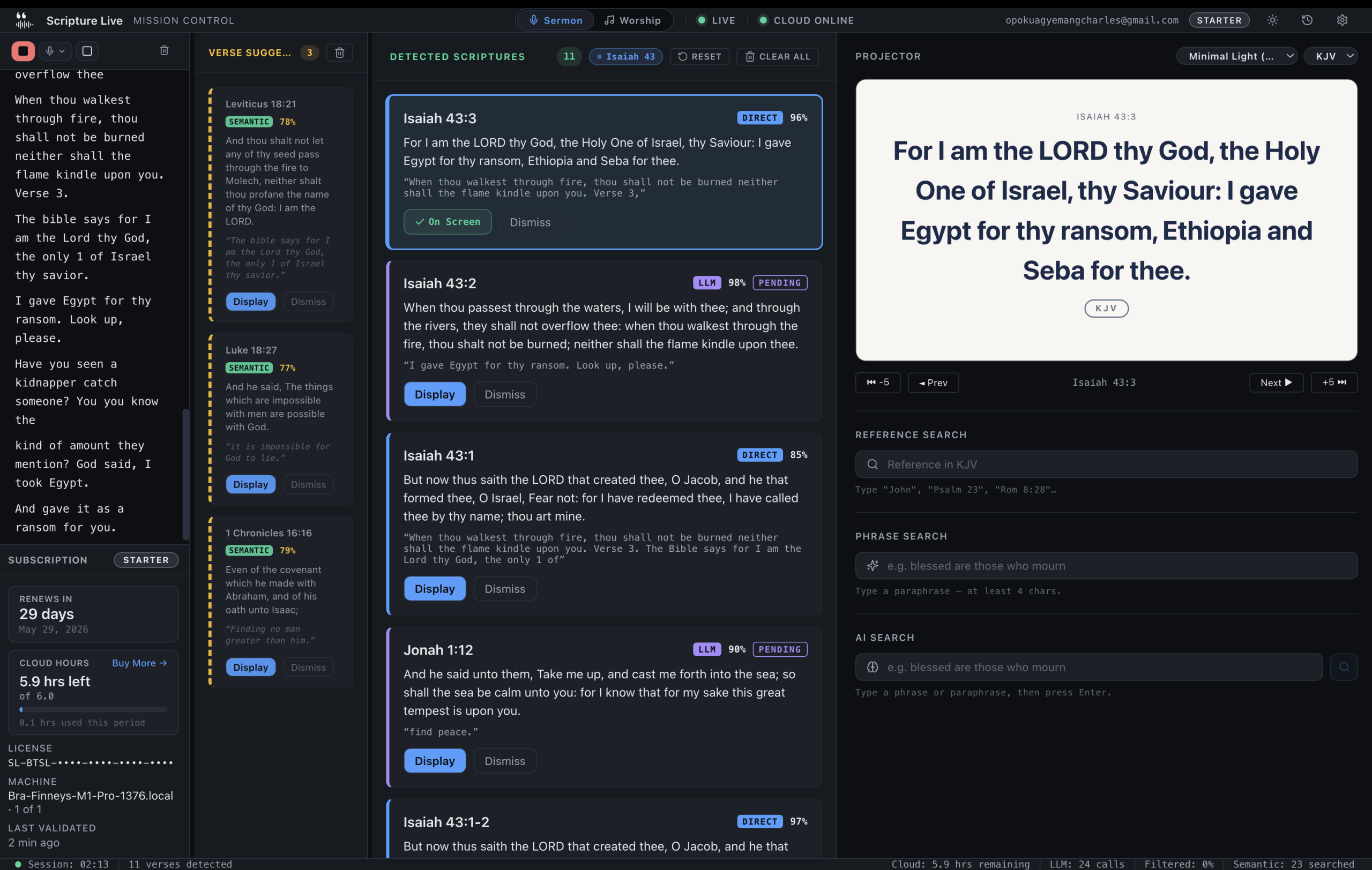
This is the central capability that motivated us to build Scripture Live. The pastor speaks; the system listens; recognized references appear on screen automatically. The hard cases — paraphrases, partial quotes, references-by-allusion — are where AI starts to add real value over a regex.
In practice, this is a layered problem. Direct references (“Romans 8:28”) are best handled by deterministic pattern matching — fast, cheap, no AI required. Mid-difficulty cases (“the verse about all things working together for good”) want a semantic search layer that can match on meaning, which is where on-device neural verse search earns its keep. The hardest cases — heavy paraphrases, mid-sentence shifts, mixed-translation quotes — are where a frontier reasoning model in the cloud genuinely outperforms simpler approaches.
The full breakdown of how that pipeline thinks is in the live detection article. The short version: AI does the heavy lifting, but the operator approves anything ambiguous before it goes on screen. We’ll come back to that.
2. Paraphrase search (“I half-remember the verse about…”).
The “I can almost remember it” problem is universal. The pastor, mid-sermon, wants to call up a verse from memory, only the memory is partial: “the one about the centurion saying ‘just speak the word’.” Keyword search struggles with this. Semantic search handles it cleanly.
Behind the scenes, the operator types the partial recollection into the search box and the system returns the matching verses ranked by semantic similarity. This is a low-stakes AI use — wrong answers are easy to spot and ignore, and the right answer typically appears in the top three results. The win isn’t replacing the operator’s judgment; it’s saving the operator from having to remember exact phrasing.
3. Sermon archives and search.
After the service is over, AI is useful for indexing what was said, generating searchable transcripts, and creating rough summaries that a human edits. The mistake is publishing the AI summary directly. The right pattern is “AI drafts, human edits, human signs off.” Done that way, the time savings are real and the theological risk is low.
Where AI shouldn’t replace humans
Three places, specifically.
Pastoral judgment about what to display. The pastor said something. Should it go on screen? AI can match the words to a verse, but it can’t read the room, can’t tell whether the pastor is making a passing reference or building toward a climactic moment, can’t tell whether the operator should display this verse or wait three sentences for the next one. That’s a human call — a worship-tech operator who knows the pastor’s rhythms.
Theological accuracy of summaries. Frontier models occasionally generate sentences that sound right but aren’t. In a sermon archive, that’s a problem with downstream consequences — congregants quote the summary, the summary is wrong, the pastor has to clarify next week. Always have a human review before publishing.
Real-time operator discretion. Even when detection is highly confident, there’s a class of moments where the operator should hold the verse off screen — moments of silence the pastor is cultivating, moments where the projector should stay on the previous slide a beat longer, moments where displaying the verse would interrupt rather than support. A queue with operator approval is the safety net.
The Scripture Live approach
Concretely: how does this look in our product?
The detection pipeline runs three layers in parallel. The Pattern Layer recognizes direct references in under fifty milliseconds, on-device. The Semantic Layer runs neural verse search on-device for the medium-difficulty cases. The Reasoning Layer calls a frontier model in the cloud for the hardest cases (heavy paraphrases, ambiguous references).
The Pattern and Semantic Layers can auto-display when confidence is high — direct references and clear semantic matches go on screen without operator approval, because the false-positive rate at high confidence is genuinely low. The Reasoning Layer never auto-displays. Even when the cloud model is highly confident, the result lands in a queue and the operator clicks Display to put it on screen. This is the line we draw deliberately: AI confidence is necessary, but it’s not sufficient for the riskiest detections.
The result, in practice: a typical sermon generates 15-25 verse displays, of which maybe 18 are auto-displayed (Pattern + Semantic Layers), 5 are queued for operator approval (Reasoning Layer), and 1-2 are dismissed by the operator as wrong-context. The operator’s job shifts from “type fast” to “approve fast” — a much better fit for volunteer-staffed booths.
Privacy and cost considerations
Two practical points that get lost in the AI marketing cycle.
Privacy. When AI runs in the cloud, your sermon audio leaves your building. For most churches this is fine — sermons are public — but some pastoral conversations and small-group settings have a different expectation. Scripture Live runs the Pattern and Semantic Layers entirely on-device; nothing leaves the laptop. Only the Reasoning Layer (the hardest cases) sends anything to a cloud backend, and even then it’s a transcript fragment, not raw audio. We think that’s the right default.
Cost. Frontier models cost real money per call. Tools that pretend “AI is free” are either subsidizing it or quietly capping usage. We charge for cloud detection hours on paid tiers (6 / 18 / 40 hours per month at Starter / Team / Church) precisely because the underlying API costs need to be recovered clearly. If a competitor’s pricing seems too good, ask how much cloud reasoning is actually included — the answer is usually “not as much as the marketing implies.”
When AI gets it wrong
It will. The question is what happens when it does.
The bad version: AI confidently displays the wrong verse, the operator can’t intervene fast enough, the congregation sees the mistake, the pastor pauses awkwardly, the moment is broken.
The good version: AI confidence is gated by a queue, the operator sees the suggestion before the congregation does, an obvious wrong-answer gets dismissed in half a second, the right one gets displayed instead. The operator is the safety net.
We’ve seen specific failure modes worth flagging. Frontier models occasionally hallucinate verse boundaries — the right book and chapter, but verses 12-14 instead of 12-15. The Pattern Layer’s strict regex sometimes fires on book names that aren’t actually scripture references (“the Jeremiah on Wall Street” — yes, this happened). Semantic search can match the meaning but pick the wrong translation.
The mitigation isn’t “make AI perfect.” That’s a research problem on a 5-year horizon. The mitigation is “design the workflow so AI failures are caught cheaply.” A queue with operator approval, a 30-second deduplication window, a confidence threshold that gates auto-display — all of these are workflow decisions that compound to make the worst-case far less bad.
What’s plausibly coming in 2027 and beyond
Without overpromising:
- Multilingual real-time detection. Right now Scripture Live works well for English and Twi sermons; mid-sermon code-switching between English and Twi is mostly handled, mid-sermon switching to Yoruba or Swahili less so. By 2027-2028 we expect the underlying transcription models to handle code-switched speech reliably enough to ship full multilingual detection.
- Sermon-level context. Today the detection pipeline operates on a sliding window of 1-3 transcript segments. Tomorrow’s models can hold the entire sermon in context, which lets them resolve ambiguous references by knowing what the sermon is about. This is a real accuracy improvement, not a marketing one.
- Better at theology, not just text. A model that knows enough biblical theology to recognize when a paraphrase is almost a verse but the speaker is actually making a different point. We’ll get there. Not in 2026.
What we don’t think is coming soon: AI that replaces the operator entirely. Pastoral judgment isn’t a small remaining edge case; it’s the central job. AI is going to keep making the operator faster, not absent.
FAQ
Is Scripture Live’s AI accurate? Accuracy depends on the layer. Direct references hit ~99% accuracy. Semantic matches on paraphrases run ~85-92% depending on the speaker. Reasoning Layer on hard cases is ~80-88% but always queues for operator approval. The combined system, with the operator as safety net, hits ~99% practical accuracy on what actually appears on screen.
Does the AI listen even when I’m not in service? No. Audio capture only runs while a session is active in the app, and the cloud Reasoning Layer only fires during paid sessions on a paid tier. Outside of an active session, nothing is listening or transmitting.
Can the AI work offline? The Pattern Layer and Semantic Layer run entirely on-device — no internet required. The Reasoning Layer needs cloud connectivity. Offline Mode (the free tier) doesn’t include detection at all; for an offline-friendly setup, see the offline mode article.
Is there an AI sermon-summary feature? Not in 2026. We’ve been deliberate about not shipping a feature whose failure modes (theological inaccuracy in published archives) are worse than its win (time savings on transcript editing). If we ship it, it’ll be a “AI drafts, human edits, human signs off” workflow, never a “AI publishes” one.
How do I know when AI is making a decision versus when I am? Detection results are color-coded by source layer in the operator UI — Pattern (deterministic), Semantic (on-device AI), Reasoning (cloud AI). High-confidence Pattern and Semantic results auto-display; everything else queues for operator approval. You always see what triggered which result.
AI in church technology is real, useful, and worth being thoughtful about. If you’re shopping for tools that take a measured approach — AI doing the heavy lifting, humans holding the discretion — Scripture Live is built around that philosophy. We have a longer treatment of why a church might want this kind of tool if you’re earlier in the decision; the free version at scripturelive.app lets you see the workflow firsthand without committing to anything.
Related reading
- How live scripture detection works
- Scripture Live vs ProPresenter
- Why your church needs Scripture Live
Try Scripture Live
Free Offline Mode includes the KJV and Twi Bibles, reference and phrase search, custom slides, and the OBS browser-source feed — install on as many machines as you want, no account needed.
📥 Download: scripturelive.app
💵 Pricing: scripturelive.app/pricing












Leave a Reply