
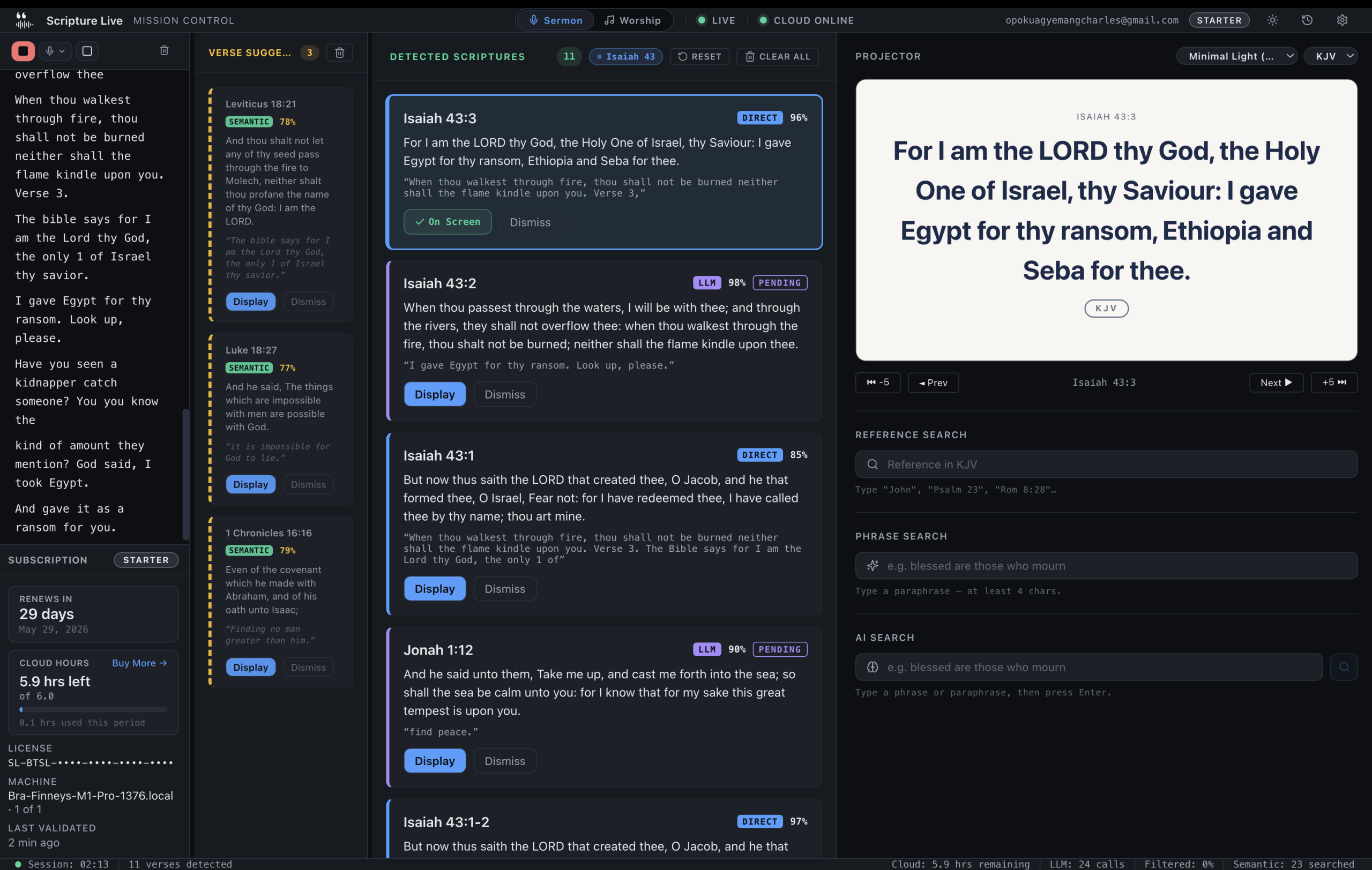
A Bible projection app for Twi-speaking and African churches
TL;DR
– Twi (Akan) Bible bundled in every install — free tier and up. No download or import.
– Pricing in GHS, Mobile Money / Paystack accepted, no FX exposure.
– Designed African-first: works offline, low-bandwidth tolerant, no constant cloud dependency.
A pastor in Kumasi opens his laptop on Saturday night, downloads a popular church projection tool — one of the big American ones — and tries to set up for Sunday’s service. By Sunday morning he’s hit three walls. The Twi Bible isn’t in the translation list. The pricing is in dollars, paid by card, which means routing the church’s monthly subscription through a personal account because the church’s Mobile Money setup doesn’t fit. And when the Wi-Fi cuts out during the offering on Sunday, the app freezes mid-verse because half its features assume a constant cloud connection.
This is a familiar story. The church-technology market — Bible projection apps, worship presentation tools, sermon broadcast software — was built almost entirely for English-speaking churches in the United States and United Kingdom. It works well in those rooms. It fits less well, sometimes much less well, in the rooms where most church-tech buyers in Ghana, Nigeria, Kenya, and across the continent actually operate.
We built Scripture Live as a Bible projection app for Twi-speaking and broader African churches first, and for everyone else second. This article is about why that distinction matters and what changes when you build the product the other way around.
The blind spot in the global church-tech market
There are five or six legitimately good projection tools in the global market — ProPresenter, EasyWorship, OpenLP, MediaShout, and a few newer entrants. Most of them are built by American or British teams, for American or British churches. That’s not a criticism; you build for the customers you have. But it does mean a few specific gaps consistently show up when those tools land in African churches.
Translation gaps. Mainstream English translations are well-supported (KJV, NIV, ESV, NLT, MSG). Twi (Akan), Yoruba, Igbo, Swahili, Amharic, Zulu, Hausa — usually not, or available only via manual import that requires technical setup most volunteer operators can’t do.
Pricing in dollars. A USD $25/month subscription is roughly GHS 350-400 depending on the exchange rate that week. Paid by card, in dollars, with FX fees on top. That’s friction even before the church can use the product.
No Mobile Money / Paystack rails. A meaningful share of African church operations runs on Mobile Money — MTN, AirtelTigo, Vodafone Cash, M-Pesa. Subscriptions paid via card (especially personal cards, since church cards aren’t always available) feel awkward and create accounting headaches.
Cloud-only architecture. Many newer tools assume a constant cloud connection — for license validation, asset storage, even basic feature unlocks. In rooms where the internet drops three times a service, that’s a problem. The app should degrade gracefully, not freeze.
English-first speech recognition. Tools that include sermon-audio detection (the newer category Scripture Live is part of) often only support English, or English plus Spanish. A pastor preaching in Twi gets nothing from these features.
None of these gaps are unfixable. They just don’t fix themselves until someone builds for the rooms where the gaps hurt. That’s the work we set out to do.
What Scripture Live does differently
Specifics, because the difference is in the details.
The Twi (Akan) Bible is bundled in every install — free tier and up. Not a paid add-on. Not a download-on-first-launch. Not a manual import. You install the app, you have a Twi Bible. Same for KJV. Both translations are inside the installer (the installer is around 600MB precisely because we ship the Bibles offline).
The implication: a Twi-speaking church on the free tier has a Twi Bible projector working in twenty minutes from download to first verse on screen. No hunting for translation files. No subscription required just to access the Bible the pastor preaches from.
Pricing is in GHS, not USD. Starter is GHS 200/month. Team is GHS 400/month. Church is GHS 800/month. Yearly billing is 10× monthly — so GHS 2000, GHS 4000, GHS 8000 for the year, which works out to two months free. Local pricing means you’re not exposed to FX swings, and the numbers on the invoice are the numbers you actually budget against.
Mobile Money via Paystack. The payment flow goes through Paystack, which means MTN Mobile Money, AirtelTigo Money, Vodafone Cash, USSD, and bank transfers all work natively. You don’t need a card. You don’t need a USD-denominated payment processor. You can pay from the same phone the church uses for everything else.
Permanent free tier that works offline. No trial timer. No “log in to unlock.” The free tier is the whole projection app with cloud features off — reference search, on-device phrase search, custom slides, projector window, OBS feed, both bundled Bibles. We covered the full feature list in the Offline Mode write-up, but the headline is: a church with no internet at all can run the free tier indefinitely.
Built by a Ghanaian founder. The product gets shipped from Accra. The Twi Bible is in the installer because the founder grew up with it, not because someone in San Francisco saw a market opportunity. Decisions get made with African churches as the first customer, not the third.
These choices stack. A Twi-speaking church plant with no AV budget and a flaky Wi-Fi connection can be projecting scripture by the end of the day, for free, in their own language, paid for (when they upgrade) through the same channel they pay for everything else.
The mixed-language sermon reality
If you’ve sat in a service in Accra, Lagos, or Nairobi recently, you’ll have heard this: pastors move between languages mid-sermon. A Twi-speaking pastor will preach a paragraph in Twi, switch to English to quote a verse, switch back to Twi to explain it, deliver a punchline in pidgin or local slang, and read the next verse in either language depending on what the congregation responds to.
This is normal. It’s good preaching. And it’s invisible to most projection tools.
Scripture Live’s live detection pipeline (paid tier) handles mixed-language sermons because the architecture is layered:
- The Pattern Layer catches direct references in either language as long as the speech-to-text feed transcribes them — “John three sixteen” and “Yohane mmiɛnsa, ɔdo ne nkron” are both reference patterns the system recognises.
- The operator can switch the displayed translation independently of what the pastor is reading from. Pastor reads a verse in English from KJV; operator displays the Twi version on screen so the congregation sees it in their preferred language. Or vice versa.
- The Reasoning Layer can recognise paraphrases regardless of which language the pastor used to deliver them, as long as the underlying reference is in our index.
The full technical picture — how the three-layer detection pipeline works in practice — is in the live detection article. For a mixed-language pastor, the practical effect is that the operator stops scrambling to figure out which translation to project for each verse — they just pick the language the congregation prefers and let the system handle the matching.
The intermittent-internet reality
Not every church has stable internet. Not every church can afford stable internet even when it’s available. And even churches with fibre fail to anticipate the Sunday a construction crew cuts the cable up the street.
Scripture Live’s architecture treats unstable internet as a normal operating condition, not an exception:
- Reference search runs entirely on-device. No internet required.
- Phrase search runs entirely on-device using the Semantic Layer’s neural verse search. No internet required.
- The projector window and OBS browser-source feed work without internet. Both run locally on the operator’s machine.
- Custom slides — sermon notes, prayer points, offering details, series art — work without internet.
- The bundled translations (KJV, Twi) are inside the installer, indexed for search, available the moment the app launches.
What requires internet is only the live detection from sermon audio — the speech-to-text feed and the cloud Reasoning Layer for paraphrases. If the internet drops mid-service, the app degrades gracefully: the in-room projector keeps showing whatever’s currently on screen, the operator can fall back to manual reference search, and verses already displayed stay where they are. When the connection returns, detection resumes.
This is the difference between an app designed for unstable internet and an app patched to handle it. Our default assumption is that the internet will fail at some point during the service. We built around that assumption.
A workflow walkthrough for a Twi-speaking church
Concrete picture of what a normal Sunday looks like.
Saturday night. The operator opens Scripture Live on the booth laptop. They set Settings → Translation to TWI. They cue up the morning’s custom slides — welcome message, offering details, pastor’s name, sermon title — using the Custom Slides feature documented in the slides article. They confirm the projector is the active output via the Display picker.
Sunday morning, pre-service. Operator hits the projector test, confirms the welcome slide is showing. Hits Start Listening before the service begins. The transcript pane fills as the pre-service announcements happen.
Worship set. Operator switches to the lyrics flow — same workflow as scripture, different sources. Lyrics show on screen and on the OBS feed if the service is being streamed.
Sermon begins. Pastor reads the day’s main passage from the Twi Bible. Pattern Layer catches the reference, the verse appears on screen in Twi within a second.
Pastor switches to English. “In the King James version, this reads as…” — operator drops the translation dropdown, switches to KJV for the next display. Pattern Layer catches the next reference in English, the verse appears in KJV. Pastor switches back to Twi; operator switches back to TWI.
Pastor paraphrases. “Onyankopɔn yɛ ɔdɔ” (God is love). The Semantic Layer recognises the paraphrase and offers 1 John 4:8 as a one-click suggestion. Operator confirms; verse on screen in Twi.
Internet drops mid-sermon. Detection pauses. The verse currently on screen stays. Operator switches to manual reference search for the next verse. Service continues without anyone in the congregation noticing.
Internet returns. Detection resumes automatically.
Service ends. Operator stops the listener. The session log (paid tiers) records every verse displayed, every detection source, every translation. The operator reviews next week’s prep against this week’s actuals.
That’s the standard shape. Nothing in it requires the operator to be a software engineer.
Why we ship to Africa first
A short answer to the question we get from US churches sometimes: why is the pricing in GHS, why is Twi the second translation in the free tier, why isn’t this targeted at us first?
Because the gap was bigger here. The American church-tech market has fifteen good products competing for it. The African market had a few products that had been retrofitted for it, and a lot of churches making do with manual PowerPoint decks and screen-shared web Bibles. A new product builds for the customer who needs it most — that’s good business and it’s also the right thing to do.
Scripture Live works exactly as well in Atlanta as it does in Accra. The free tier installs the same way. The paid features unlock the same way. Cards work fine if you don’t have Mobile Money. The detection pipeline catches English references in Atlanta the same way it catches Twi references in Accra. We just didn’t start in Atlanta.
For a fuller picture of the product across all markets, the broad case for Scripture Live covers the workflow at a higher level.
FAQ
Q: Is the Twi Bible really included for free?
Yes. The Twi (Akan) Bible is bundled in the free tier installer, indexed for full-text search, and available without an account.
Q: Can I pay for the paid tiers using Mobile Money?
Yes. Payment goes through Paystack, which supports MTN Mobile Money, AirtelTigo Money, Vodafone Cash, USSD, and bank transfers in addition to cards.
Q: What other African languages are supported?
Twi (Akan) is the African language we ship today. We’re prioritising Yoruba, Igbo, Swahili, and Amharic next, in roughly that order, based on user demand. If your church needs a translation we haven’t shipped yet, write to us — we keep a backlog and prioritise based on community pull.
Q: Will it work if my church’s internet is unreliable?
Yes. Reference search, phrase search, custom slides, and the projector and OBS feed all work entirely offline. The only feature that requires internet is live detection from sermon audio, and even then the app degrades gracefully when the connection drops.
Q: How much does it cost in GHS?
Free tier is permanent, GHS 0. Starter is GHS 200/month, Team is GHS 400/month, Church is GHS 800/month. Yearly billing is 10× monthly across tiers, which works out to two months free.
Get started
If you’re a Twi-speaking pastor or a tech lead at an African church and you’ve been making do with tools that don’t quite fit, download Scripture Live on your booth machine and run one Sunday with it. The free tier is permanent, the Twi Bible is included, and there’s no account required to evaluate it. Everything is at https://scripturelive.app.
Related reading
- Offline Mode: free Bible projection
- Free vs paid: when does it matter?
- Why your church needs Scripture Live
Try Scripture Live
Free Offline Mode includes the KJV and Twi Bibles, reference and phrase search, custom slides, and the OBS browser-source feed — install on as many machines as you want, no account needed.
📥 Download: scripturelive.app
💵 Pricing: scripturelive.app/pricing










Leave a Reply