
Watch: Full Editorial (9:16)
There is a story the Western fintech press has been telling about Africa for fifteen years. It goes like this: M-Pesa in Kenya is a fascinating case study. Someday, as incomes rise, Africans will graduate to real banking — Visa cards, credit scores, the whole stack. It was the narrative in 2012. It was the narrative in 2018. It is, somehow, still the narrative in most business coverage today.
It is also completely wrong.
The number almost nobody is quoting
In 2025, mobile money wallets across Africa processed $1.4 trillion in transactions. That is not a typo. One point four trillion dollars. Two-thirds — roughly 66 percent — of the entire $2.09 trillion global mobile money flow now happens in Africa. The continent everyone said was the case study is now the whole market.
For scale: it took the mobile money industry twenty years to process its first $1 trillion in annual transactions. It took just four years to double from $1 trillion to $2 trillion. The curve isn’t linear. It isn’t even exponential in the normal sense. It is vertical.
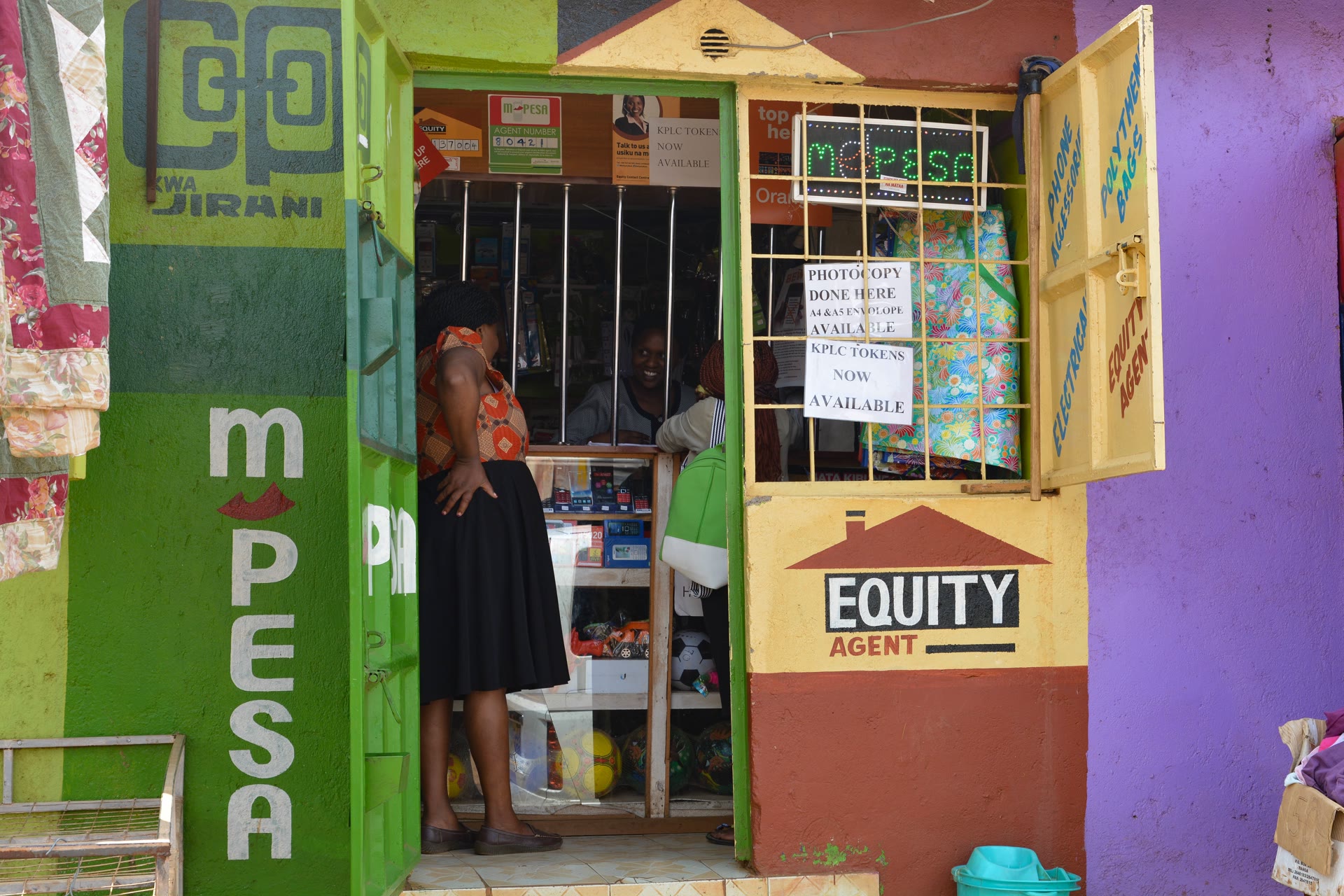
By the end of 2025 Africa had 562 million mobile money users, and 58.2 percent of sub-Saharan African adults now own a financial account of some kind — a share that was under 25 percent a decade ago. Most of that expansion had nothing to do with bank branches opening. It happened on phones. Much of it happened on phones that don’t even have internet — just a SIM card and a USSD menu.
This is not “banking the unbanked.” This is an entirely different payments infrastructure, parallel to the Western one, that has already eaten the consumer end of the market.
The big four
The scale is concentrated in four names most Silicon Valley fintech investors still struggle to spell.
M-Pesa (Safaricom / Vodacom), born in Kenya in 2007, is still the flagship. 68 million monthly active users across seven countries. Annual transaction volume: $450.8 billion. That is nearly half a trillion dollars flowing through what is technically a telco product, not a bank.
MTN MoMo, the mobile money arm of South Africa’s MTN Group, has 63.2 million monthly active users across 13 African markets. Annual transaction volume: $424 billion.
Airtel Money, owned by Indian telco Bharti Airtel, runs across 14 African countries with 49.8 million monthly active users. Annual transaction volume: $193 billion — and growing at roughly 36 percent year on year.
Wave, the youngest of the four, is the one Western investors keep missing entirely. Founded in Senegal, it became Francophone Africa’s first tech unicorn. It charges a flat 1 percent fee for sending money, zero for receiving or paying utility bills, and has 29 million monthly active users including more than 8 million in Senegal alone. In Côte d’Ivoire, mobile money adoption rose from 30 percent of the population in 2016 to 83 percent in 2021. That shift was almost entirely driven by Wave.
Add them up and the rough picture is this: more than 210 million active mobile money users and over $1 trillion in annual flows — just from four companies — across a continent where formal banks still only reach a minority of adults. Traditional banking never arrived. Something else did, and it was built for the real customer.
The thing Mastercard finally admitted
For two decades, the Western payments giants treated Africa as “future potential.” Card penetration was low, point-of-sale infrastructure was patchy, the right move seemed to be to wait until the middle class caught up.
Then in February 2024, Mastercard wrote a check for $200 million — for a 3.8 percent stake in MTN Group Fintech, valuing the MoMo business at $5.2 billion. They signed a 13-market deal to slap a virtual Mastercard onto every MoMo wallet, effectively plugging MTN’s 60 million users into 100 million Mastercard acceptance locations worldwide.
Read that carefully. Mastercard did not expand into Africa. Mastercard bought distribution on top of an African payments network that already exists and already moves more money than any card scheme in most of the continent. The prestige hierarchy Western fintech assumed — Visa and Mastercard at the top, mobile wallets underneath — just got formally reversed in Mastercard’s own cap table. MTN is the platform. Mastercard is the feature.
Visa has not done an equivalent deal yet. It is hard not to read that as a strategic problem rather than a choice.
Why this was always going to happen
There is a simple reason mobile money won in Africa. It was designed for Africa. Western payments infrastructure assumes a chain of trust and identity: you have a bank, the bank issues a card, the card runs on a network, the network settles with another bank. Every step in that chain requires ID verification, credit history, a permanent address, a stable employer — assumptions that don’t hold for most of the continent.
Mobile money threw the chain out. The telco already knows who you are — your SIM is your identity. The telco already has a balance with you — your airtime. The telco’s network of agents replaces bank branches. Cash in, cash out, person to person, merchant payment, bill payment, international remittance. The whole stack collapsed into a phone number.
What Western fintech kept framing as a stopgap — “until real banking arrives” — was actually the finished product. It is cheaper, faster, and more inclusive than anything Visa and Mastercard could build on top of legacy banking rails, because it is not built on top of legacy banking rails at all.
The story nobody’s telling
The global fintech press is still writing about M-Pesa as if it were 2010. The 2026 story is entirely different. It is that Africa has silently built the largest mobile-native consumer payments system on Earth, that it processes two-thirds of global mobile money volume, and that the Western card networks have shifted from competing with it to paying for a seat inside it.
That is a bigger inversion than any Silicon Valley “disruption” narrative of the last decade. A market the venture class wrote off as pre-product is now the product the rest of the world has to reverse-engineer.
When Mastercard’s CEO talks to shareholders about the future of global payments, he talks about partnerships in Africa. When Visa’s CEO talks about it, he talks about emerging markets risk. One of those framings is already out of date.
Mobile money in Africa is no longer a curiosity. It is a category-defining winner, it moved more than a trillion dollars last year, and it belongs on the short list of the most important financial infrastructures built anywhere this century.
The only people still treating it as a side story are the ones who missed it.



Leave a Reply