
Watch: Full Editorial
For thirty years, the IMF, the World Bank, and every visiting consultant with a PowerPoint told African governments the same thing: privatise your airlines. State ownership, they said, was the disease. Nepotism, political appointments, bailouts, bloated staff — those were symptoms of a flag carrier being run by a government instead of a board.
The doctrine was followed. Nigeria Airways was liquidated in 2003 with $528 million in debt and a single working aircraft. South African Airways has absorbed more than R28 billion in losses and spent 16 months in bankruptcy protection. Kenya Airways — half-privatised in 1996 and held up as the model — has received three taxpayer bailouts in the last seven years and is still insolvent. Air Afrique, the pan-African carrier that once linked eleven countries, was dismantled in 2002. Ghana Airways. Cameroon Airlines. Air Zimbabwe. Zambia Airways. The list of defunct African flag carriers is longer than the list of surviving ones.
And then there is Ethiopian Airlines.
The numbers that embarrass the doctrine
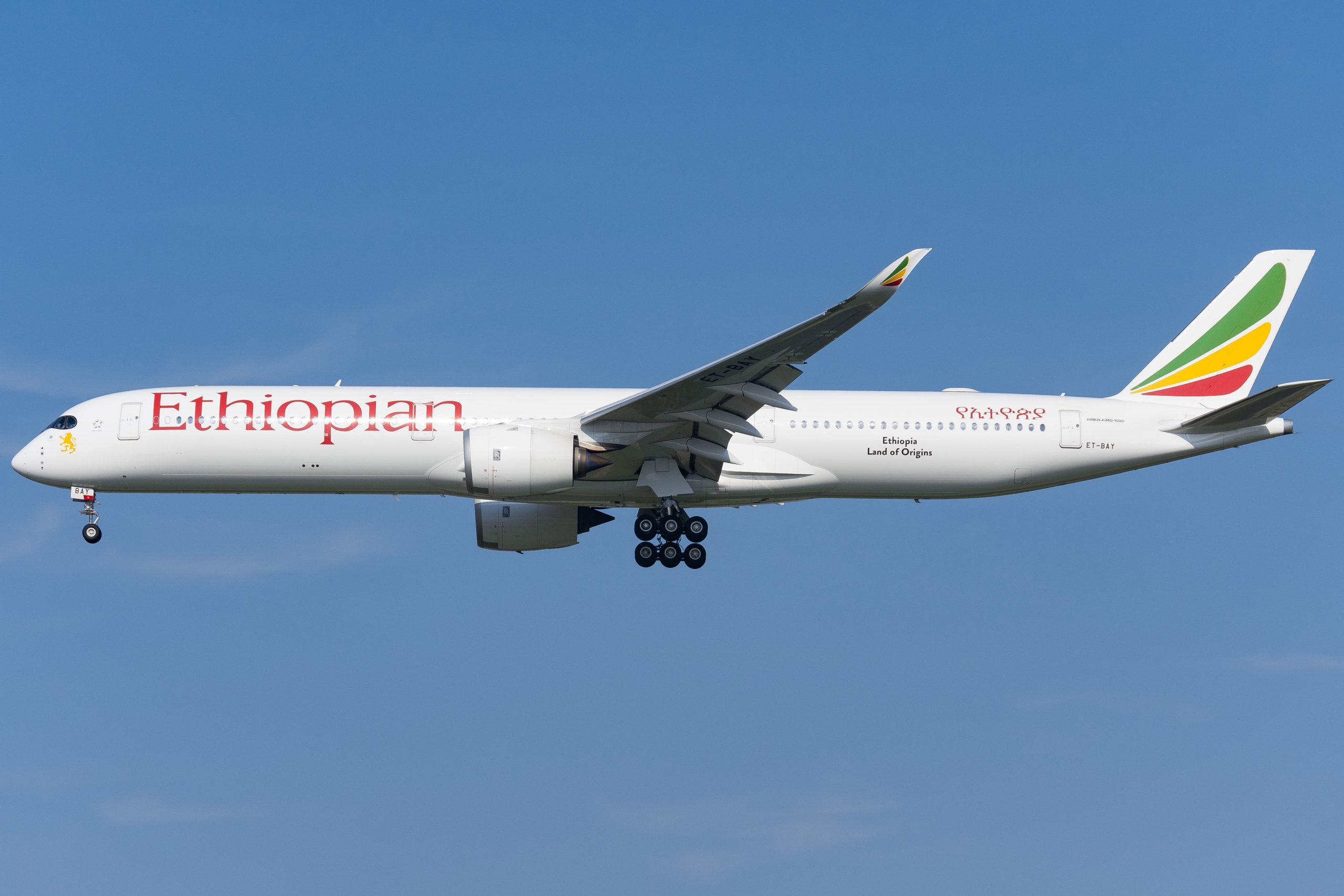
Ethiopian Airlines is 100 percent owned by the Government of Ethiopia. No minority private stake. No listed shares. No strategic foreign partner. A textbook state-owned enterprise — the exact thing Washington spent three decades warning Africa not to be.
In its 2024/25 fiscal year, the airline booked $7.6 billion in revenue, up 8 percent year on year. It carried 19 million passengers — 15.2 million international, 3.9 million domestic. It operates 146 aircraft, added 13 new ones in the last year alone, and flies to 155 passenger destinations across the world, plus 68 freighter destinations as the largest air cargo operator on the continent.
In the first half of fiscal 2025/26, it pulled in another $4.4 billion in revenue and moved 10.64 million passengers — an eleven percent jump on the same period the year before, beating its own targets by two percent.
Ethiopian Airlines has been continuously profitable for nearly two decades. In 2024, its passenger-carrying capacity roughly equalled Africa’s second, third, and fourth largest airlines combined. It is a member of Star Alliance. It owns secondary hubs in Togo and Malawi. It is breaking ground on a $12.5 billion megahub at Bishoftu — the largest airport project in African history.
This is a state-owned company. This is the thing that was supposed to fail.
The heresy
The uncomfortable answer is this: state ownership was never the problem. Political interference was.
Every failed African flag carrier shares the same cause of death — and it is not ownership structure. It is that the government used the airline as a patronage tool. Board seats went to loyalists. Routes were chosen for diplomatic vanity instead of load factor. Staffing doubled for every election cycle. Fuel contracts went to cousins. CEOs changed with every cabinet reshuffle. The airline became an extension of the presidential palace.
Ethiopia did not do this.
The Ethiopian government, for reasons that are still being studied by management academics, made one decision that separated it from every other African flag carrier: it hired its airline managers on merit and then left them alone. No political appointees. No patronage staffing. Career aviation professionals, trained in-house at the Ethiopian Aviation University, promoted internally. Tewolde GebreMariam, who ran the airline for eleven years through its greatest expansion, spent his entire 33-year career inside the company before becoming CEO. His successor, Mesfin Tasew, spent ten years as Chief Operating Officer before stepping up. Both were engineers. Neither was a politician.
The airline runs as a commercial entity. It sets its own fares. It chooses its own routes. It buys its own aircraft. When the government wants something, it asks — it does not instruct. That single boundary, maintained across five decades and multiple changes of government including civil war, is the entire story.
What this breaks
This breaks the Washington consensus narrative so thoroughly that most Western business press still refuses to say it out loud. The standard coverage of Ethiopian Airlines describes it as “uniquely well-run,” as if it were a lucky genetic mutation. It isn’t. It is a reproducible management model that every African country could, in principle, have adopted.
The implication is devastating: the privatisation push of the 1990s and 2000s was not the solution to the problem. It was a way of outsourcing the problem of political interference instead of confronting it. Countries that privatised their flag carriers — Ghana, Kenya partially, Zambia — still watched them die, because the same political class that would have raided a state-owned airline was now allowed to raid the privatisation process itself. Asset-stripping replaced overstaffing. The airline died faster, not slower.
Meanwhile, the country that simply drew a firewall between the cabinet and the C-suite produced the most successful airline in the continent’s history.
The uncomfortable lesson
Ethiopian Airlines is not a miracle. It is an indictment.
It is what happens when a state-owned enterprise is run by people who know what they are doing, shielded from politicians who don’t. It is proof that the problem African industry has faced for sixty years was never fundamentally about ownership — it was about governance discipline. And the countries that blamed state ownership were, quietly, letting themselves off the hook for the real failure.
Vision 2035, the airline’s current roadmap, targets 271 aircraft, 207 international destinations, 65 million passengers, and $25 billion in revenue by the middle of the next decade. If it hits even half of those numbers, Ethiopian Airlines will be bigger than most European flag carriers and operating at a scale that will force a rewrite of the textbooks on African industrial policy.
The lesson is not that every African government should rush back into running state enterprises. It is that when they do, the question is not whether the state owns it — it is whether the state has the political maturity to not touch it. That is the quiet discipline that Addis Ababa figured out and almost nobody else has.
Everyone said Africa’s airlines failed because they were state-owned.
The one state-owned African airline nobody would privatise is the one that works.
That is not an accident. That is the whole story.










Leave a Reply